
Privacy aaj ke digital world ka sabse important legal topic ban chuka hai. Chahe aap India mein ho ya United States mein, aapka personal data, online activities, aur private life kanooni protection deserve karti hai.
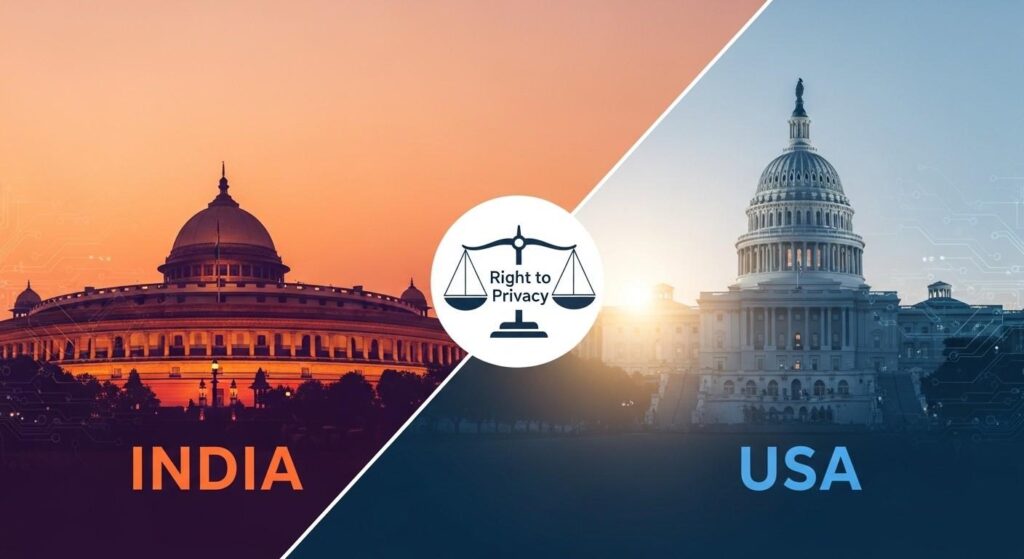
India mein Right to Privacy ko Supreme Court ne fundamental right declare kiya hai, jabki USA mein ye constitutional interpretation ke through evolve hua hai. Dono countries privacy ko protect karti hain, lekin unka legal framework kaafi alag hai.
Is article mein hum India aur USA ke privacy laws, landmark judgments, practical rights, aur key differences ko detail mein samjhenge.
Right to Privacy in India
India mein Right to Privacy ek Fundamental Right hai jo Article 21 ke under protected hai.
Supreme Court ne historic judgment mein privacy ko recognize kiya:
Supreme Court ne Article 21 ke under right to privacy recognize kiya (Justice K.S. Puttaswamy (Retd.) v. Union of India, (2017) 10 SCC 1*)*.
Is judgment ne clear kiya ki privacy human dignity, autonomy, aur liberty ka essential hissa hai.
Indian Legal Framework
- Article 21 – Right to Life and Personal Liberty
- Digital Personal Data Protection Act, 2023
- Information Technology Act, 2000
- Relevant provisions under Bharatiya Nyaya Sanhita (BNS)
Practical Rights in India
Indian citizens ko milte hain:
- Personal data protection
- Informational privacy
- Bodily privacy
- Decisional autonomy
Important Indian Cases
- Justice K.S. Puttaswamy v. Union of India (2017)
- People’s Union for Civil Liberties v. Union of India (1997)
Common Man Ke Liye Kya Matlab?
- Government arbitrary surveillance nahi kar sakti.
- Companies bina consent personal data collect nahi kar sakti.
- Aadhaar aur digital records legal safeguards ke under aate hain.
Right to Privacy in the United States
In the United States, the Right to Privacy is not explicitly mentioned in the Constitution. Instead, it has been recognized through judicial interpretation.
The U.S. Supreme Court has derived privacy rights from several constitutional amendments, including the First, Fourth, Fifth, Ninth, and Fourteenth Amendments.
Key U.S. Supreme Court Cases
- Griswold v. Connecticut, 381 U.S. 479 (1965)
- Katz v. United States, 389 U.S. 347 (1967)
- Roe v. Wade, 410 U.S. 113 (1973)
- Carpenter v. United States, 585 U.S. ___ (2018)
Major Privacy Protections
- Fourth Amendment protection against unreasonable searches
- Sector-specific federal laws like:
- HIPAA (health data)
- COPPA (children’s data)
- FCRA (credit information)
Why It Matters to Indian Readers
Many global tech companies operate under U.S. law. Understanding American privacy law helps Indian users better protect their rights on international platforms.
India vs USA: Side-by-Side Comparison
| Feature | India | United States |
| Constitutional Status | Explicitly recognized by Supreme Court | Implied through judicial interpretation |
| Primary Source | Article 21 | Multiple Amendments |
| Landmark Case | Puttaswamy (2017) | Griswold (1965) |
| Data Protection Law | DPDP Act, 2023 | Sectoral laws, no single federal law |
| Scope | Broad and comprehensive | Fragmented but robust |
Key Similarities
- Both countries recognize privacy as a vital liberty.
- Courts play a central role in defining privacy rights.
- Government surveillance is subject to legal limits.
Key Differences
- India has a unified constitutional recognition.
- USA relies on multiple amendments and statutes.
- India recently enacted a comprehensive data law, while the U.S. still uses a sector-based approach.
Practical Guide: What Should You Do?
In India
- Read privacy policies before sharing data.
- File complaints with the Data Protection Board or cyber authorities.
- Approach courts for constitutional remedies.
In the USA
- Review platform privacy settings.
- File complaints with the FTC.
- Consult an attorney for civil privacy violations.
Universal Best Practices
- Use strong passwords.
- Enable two-factor authentication.
- Avoid sharing sensitive personal information unnecessarily.
Related LexParth Articles
- Article 21 Explained in Hinglish
- Digital Personal Data Protection Act, 2023
- K.S. Puttaswamy Case Summary
Official Sources
- Supreme Court of India: https://www.sci.gov.in
- U.S. Supreme Court: https://www.supremecourt.gov
Conclusion
Privacy modern democracy ka cornerstone hai. India aur USA dono countries privacy ko fundamental liberty ke roop mein treat karti hain, chahe unka legal approach alag ho.
Agar aap apne legal rights samajhte hain, to aap digital world mein zyada secure reh sakte hain.
⚠️ This article is for educational purposes only and does not constitute legal advice. Laws vary by jurisdiction. Consult a qualified attorney for specific legal problems.